Research & Projects
My research at the University of Notre Dame, advised by Prof. Yiyu Shi, focuses on building and evaluating reliable AI agents. Below are the problems I work on, my contributions, and the resulting systems and findings.
Memory & evaluation
MemEye: Evaluating multimodal agent memory
Problem. Agents can lose visual details or retrieve outdated evidence across conversations. Evaluations need to distinguish these failures from reasoning errors.
My contribution. Built a benchmark-construction pipeline with checks for answerability, visual dependence, and textual shortcuts; expanded coverage to 1,200 questions across eight scenarios and 12 categories.
Result. Evaluated 13 memory methods across four VLM backbones, identifying visual-detail loss, stale retrieval, and state-tracking failures as bottlenecks.
Paper ↗Project & examples ↗Code ↗Dataset ↗
Seeing, Maintaining, and Learning: Multimodal agent memory survey
Problem. Comparing memory systems requires a shared view of how they represent evidence, manage updates, and learn from experience.
My contribution. Co-developed a two-axis taxonomy connecting memory formation and representation with management adaptivity, distinguishing static, dynamic, and self-evolving systems.
Result. Curated 296 memory architectures and 83 evaluation resources across five modality categories, connecting architectural choices with evidence preservation, storage efficiency, and temporal consistency.
Reliable agent decisions
Agent Last Doubt: Risk-aware tool use
Problem. Tool-using agents must decide when to clarify, search, act, or escalate while balancing task success, interaction cost, and irreversible error risk.
My contribution. Designed an action-conditioned value model that predicts success, cost, and critical errors separately, supporting configurable inference-time trade-offs with a fixed backbone.
Output. Built a counterfactual rollout pipeline on ToolSandbox and τ²-bench to compare interventions from identical snapshots and generate outcome-based supervision.
Node-as-Agent: Graph Agentic Network
Problem. Node classification requires combining local graph structure with relevant evidence beyond a node’s immediate neighbors.
My contribution. Designed local-global memory for ReaGAN, a training-free, LLM-powered Node-as-Agent framework, combining graph-neighbor evidence with semantically relevant nodes retrieved through RAG.
Result. Evaluated frozen Qwen2.5-14B on Cora, Citeseer, and Chameleon; achieved 84.95% accuracy on Cora without task-specific fine-tuning.
Multimodal generation
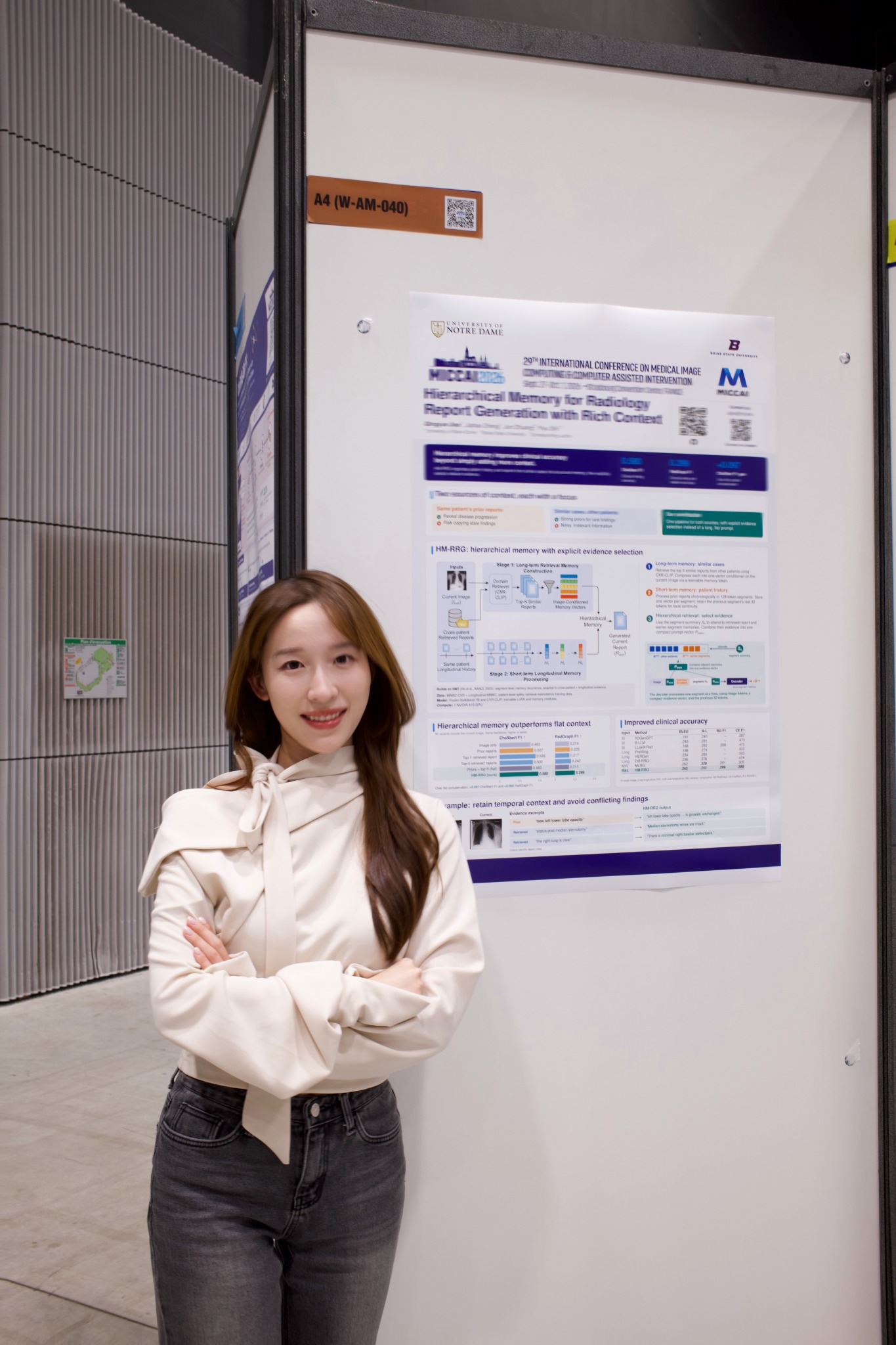
HM-RRG: Hierarchical memory for radiology report generation
Problem. Generating clinically accurate chest X-ray reports requires selecting relevant evidence from retrieved cases and long patient histories.
My contribution. Implemented image-conditioned memory compression, segment-level retrieval, and LoRA fine-tuning of BioMistral-7B within a hierarchical memory and RAG framework.
Result. Improved CheXbert clinical F1 from 0.483 to 0.580 over flat context concatenation on MIMIC-CXR, a 20.1% relative improvement. Published at MICCAI 2026.
MediQ-GAN: Medical image generation from limited data
Problem. Underrepresented medical image classes can limit classifier performance when training data are scarce.
My contribution. Ran synthetic data augmentation experiments with a prototype-conditioned hybrid GAN across three datasets and two classifier backbones. Analyzed generator Jacobian spectra and effective rank to diagnose mode collapse and latent-space utilization.
Result. Improved ViT-small accuracy on ISIC2019 from 72.49% to 82.60% using augmentation with the model’s generated images.